MULTIPLE ERROR DETECTING AND CORRECTING SYSTEM EMPLOYING REED-SOLOMON CODES
Order Number: XX-681FA-49
This document is a U.S. Patent describing an error detection and correction system for digital data transmission and storage, specifically implementing Reed-Solomon codes.
Key technical aspects include:
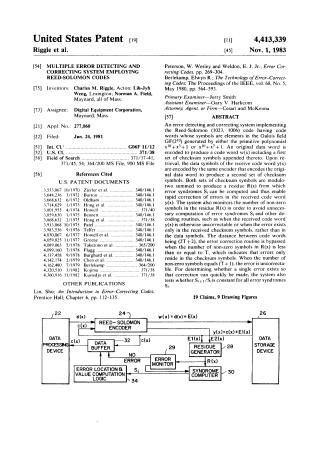
- Methodology: The system encodes original data into a codeword with appended checksum symbols using a Reed-Solomon encoder. Upon retrieval, the system re-encodes the data to generate a new set of checksums, which are then compared with the original stored checksums to produce a "residue."
Error Monitoring: The system counts the number of non-zero symbols in the residue to determine error status:
- If zero, the data is correct.
- If within a threshold (T), the system bypasses correction, as errors are identified as residing only in the checksums.
- If the number of errors exceeds a limit, the system marks the block as uncorrectable and initiates a re-read.
Correction: When errors are present, the residue is used to calculate error syndromes much faster than traditional methods, enabling real-time correction during high-speed data transfers.
- Optimization: The patent details an encoder using 10-bit symbols and specific primitive polynomials ($x^{10} + x^3 + 1$ or $x^{10} + x^7 + 1$) to provide high coding efficiency and error correction capability. It also features a specific test ($S{j+1}/Sj = constant$) for rapidly identifying and correcting single-symbol errors.
Site structure and layout ©2026 Majenko Technologies